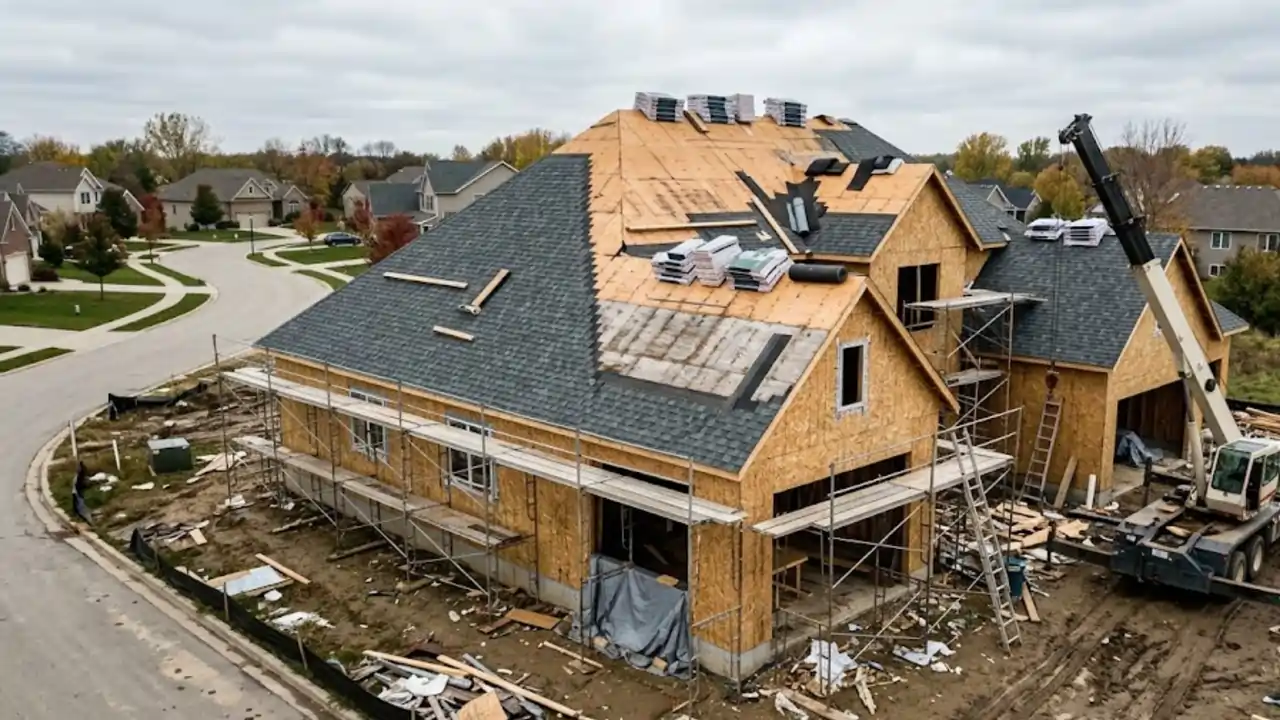
The U.S. roofing market is in a slump, and the numbers are extremely clear. Asphalt shingle shipments fell about 10% YoY in the third quarter of 2025. In early 2026, a number of companies filed for bankruptcy because reroofing demand cooled across North America.
The slump traces back to a stalled construction market, homeowner cost shock, and a set of geopolitical messes driving up the prices. Putting it all together explains why an industry built on replacement work is suddenly under strain.
The US roofing market size is still impressive despite the slump. Market research places the U.S. roofing market near $31.4 billion. Roof replacement is the still largest slice of the US roofing market with a staggering 63.5% share.
That replacement share is the single most important fact about the industry. It means that most roofing demand comes from roofs wearing out. New constructions make up a meagre 35 to 37% of the whole market.
Asphalt shingle still dominates residential roofing with a 58.6% dominant share. Metal roofing, cool roof coatings, green roofing, and solar roofing are taking a slow, steady share of the market. However, they'll still need at least a few years to shake the shingle dominance.
Based on our previous roofing industry report, awareness is compelling homeowners to choose energy efficiency and lower energy costs. Unfortunately, residential roof top solar companies are in a downturn because the 30% federal tax credit was eliminated. One example of this was Freedom Forever (second-largest US solar installer) filing for bankruptcy in April 2026.
On commercial buildings, reflective and energy-efficient roofing systems are moving from niche to standard. Large, long-established roofing companies like Baker Roofing Company hold the market share and supply chain leverage that smaller firms cannot match.
With the unfortunate squeeze in the market, smaller companies might be forced out of business more readily. Early 2026 saw a list of companies filing for Bankruptcy including Ready Roofing LLC amongst others. And it's all tied to a construction slump.
Roofing sits downstream of construction, so it moves when construction moves. Think about it like this, John is constructing a new house and no house is complete without a roof. When housing starts fall, that channel narrows immediately.
The bigger channel is repair and replacement, which runs on a different clock. Roofs installed years ago reach the end of their replacement cycles and fail on schedule. An aging housing stock feeds steady roofing demand even in a soft economy.
Furthermore, home sales usually trigger a wave of re-roofs. Homeowners replace a tired roof for curb appeal and buyers demand it before closing. Unfortunately, that second channel is freezing up.
With existing-home sales at their lowest turnover in decades, the pre-sale replacement projects simply are not happening. So construction slumps are hitting the roofing industry twice:
U.S. housing starts dropped 15.4% in May 2026 to a seasonally adjusted annual rate of 1.18 million units, according to the National Association of Home Builders. Single-family starts were down 6.7% from a year earlier, while multifamily construction collapsed 40.2% in the month.
The NAHB pinned the decline on:
Fewer new homes means fewer new roofs, and builders are staying cautious. The number of single-family homes under construction sat at 587,000 units, nearly 6% below the prior year.
Furthermore, the existing-home market is frozen. Redfin found that roughly 28/1000 homes changed hands between January and September 2025. This was the lowest turnover since at least the 1990s.
Owners are not moving, selling, or putting fresh roofs because they're locked into pandemic-era mortgages (near 4%). This is causing a freeze in the roof replacement market, squeezing smaller residential roofing companies. Demand on retailer side recounts the same tale.
Home Depot missed Wall Street expectations for a third straight quarter in late 2025. They blamed a disruptive but deep funk in the housing market for the miss. Executives described customers who keep postponing big projects while they wait out the uncertainty.
CFO Richard McPhail in an interview to Fortune said "Our customers are homeowners," pointing to the uncertainty in the housing market and its impact on the attached industry. A roof is one of the largest checks a homeowner writes and the hesitation is pummeling the roofing industry.
A quiet storm season stripped out the demand that usually cushions the industry. When the storms do not come, neither does the storm damage that fills an insurance claim and pays for a replacement. The chill is seeping to the manufacturers as well.
Owens Corning, one of the largest U.S. roofing manufacturers, reported a 10% drop in revenue in the first-quarter 2026. Roofing sales fell 14% to $960 million, and the company said the U.S. asphalt shingle market shrank about 10%.
The culprit again was a light storm season and thin carryover demand. A calm year of weather spells doom for an $31.4 billion industry that relies on replacement work. Owens Corning expects reroof demand to stay solid but slightly down through 2026 without a major storm season.
Unfortunately 2026 has been a tumultuous year globally. With succinct tariff wars, global oil shortages, and constant wars, things are taking a turn for the worst.
Roofing runs on asphalt, and asphalt is (unfortunately) a petroleum product. In simpler words, the whole industry is tied to the price of oil. Owens Corning warned of roughly $60 million in added costs in the second quarter of 2026 from inflation tied to the conflict in Iran.
Half of that will land on roofing business, with increasing overheads and lowering profit margins. Other negative geopolitical events include:
Furthermore, tariffs are stacking on top and rippling through the supply chain. Owens Corning booked about $13 million in net tariff costs in a single quarter.
The NAHB has flagged building-material trade policy as a direct hit to construction budgets. Every dollar of tariff and fuel inflation eventually reaches the homeowner's estimate. The homeowner is pushed out of the affordable zone, i.e., they can't afford the projects anymore.
The most glaring impact has been on roofing labor. Immigration enforcement has struck roofing crews head on, and one Minnesota roofing company lost most of its crew after ICE arrests.
With the trade already short on skilled roofers, raids on the workforce are turning a shortage into a full standstill. The impacts are evident for roofing contractors.
Add cooling demand to rising costs and the steam starts rising for a lot of roofing companies. And this is what has been happening since early 2026. A wave of contractors has filed for Chapter 11 in 2026, including:
Ready Roofing alone listed more than $1.13 million in liabilities against just $116,903 in assets. The pressure points are consistent across the industry. In one contractor survey:
Furthermore, insurers loom large in the wreckage, with State Farm listed as the biggest unsecured creditor in the Ready Roofing filing. Fortunately, this slump doesn't mean a collapse.
The roofing industry is still secure but companies with more liabilities are on shaky grounds. Roofs still age, leak, and fail, and most of the work is non-discretionary replacement rather than new construction. That replacement job inflow keeps the roofing industry stable.
Unfortunately, the floor in this industry doesn't mean an automatic rebound. NRCA tracked reroofing indices sat below the neutral 50 mark in late 2025. This signals contraction in the steep-slope segment that covers most homes.
The U.S. roofing market looks set to grind through 2026 in low gear, unless:
The demand for roofs has been deferred, priced up, and squeezed from three sides at once. For the roofer on the ladder, that is the whole difference between a booked-out year and a bankruptcy filing. What does this mean for you?
For the roofing industry, the slump is temporary but arduous like listening to chalk grating on a board. Roofs still fail on schedule, so the jobs will not disappear. It's now a test of time to see which roofing companies can absorb higher costs and thinner demand long enough to still be standing when the market turns.
The roofers who survive will be the ones:
The ones leaning on storm-chasing and cheap credit will fold first. Expect consolidation, with stronger contractors buying up the work left behind by the roofing companies that go under.
A roofing contractor willing to ride out the slump should:
The price of a new roof is likely to climb even as demand softens because of the slump. Brace yourself, prepare, make smart choices, and you will come out the other end without major damage.
Yes. Asphalt shingle shipments fell about 10% year over year in the third quarter of 2025, reroofing demand cooled across North America, and Owens Corning's roofing sales dropped 14% in early 2026. A rising count of roofing companies has also filed for bankruptcy.
Roofing follows construction, and construction has stalled. U.S. housing starts fell 15.4% in May 2026, homeowners are deferring big projects, and a quiet storm season removed the demand that usually keeps crews busy. Rising costs then squeezed contractors from the other side.
Asphalt is a petroleum product, so a roof's cost is tied to the price of oil. Owens Corning flagged roughly $60 million in added second-quarter 2026 costs from inflation tied to the conflict in Iran, plus about $13 million in tariff costs in a single quarter. Those increases eventually land on the homeowner's estimate.
Several have. A wave of contractors filed for Chapter 11 in 2026, including Ready Roofing, Ribbit Roofing, and Snohomish Roofing. Surveys point to rising material costs and a labor shortage as the main pressures behind the failures.
Prices are likely to rise even as demand softens. The cost pressure is coming from asphalt inflation and tariffs on building materials, not from busy crews. A weaker market does not guarantee a cheaper roof.
The market has a floor, because replacement work makes up well over 80% of a roughly $31.4 billion industry and roofs keep failing regardless of the economy. A real rebound depends on lower mortgage rates, steadier homeowner confidence, or a heavy hailstorm season. Until then, 2026 is likely to stay soft.
The U.S. roofing market is in a real slump. A stalled construction market and cautious homeowners cut the demand, while tariffs, the conflict in Iran, and a thinner labor pool drove up the cost. Caught in the middle, weaker roofing companies are already filing for bankruptcy.
Still, replacement work is the lifeline of the whole industry, and roofs keep aging no matter what the housing market does. These market dynamics reward the disciplined roofer and punish the overextended one. Until mortgage rates ease or the storms roll back in, 2026 belongs to whoever can hold the line on cost and cash.




.jpg)