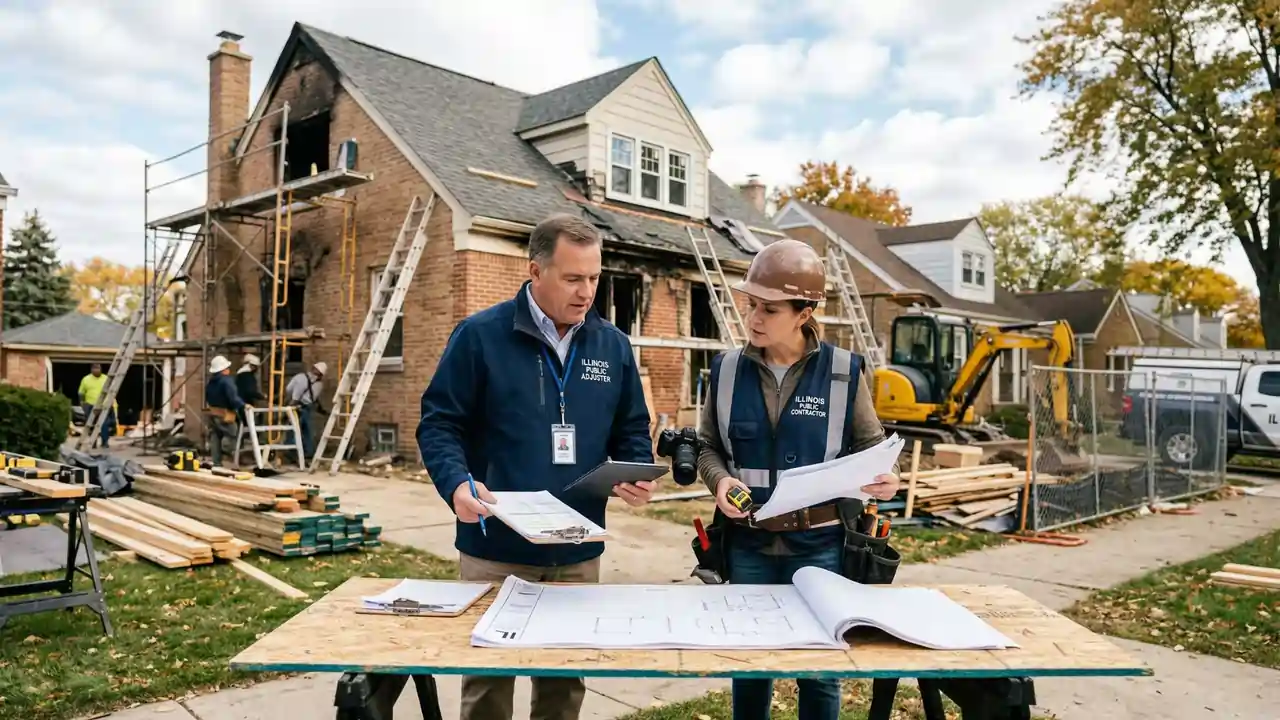
Yes, a public adjuster can also act as a contractor in Illinois. Illinois is one of the few states that explicitly permits this dual role. However, this freedom also comes with some strong rules and regulations.
Countless people opt for this dual role without learning about the limitations. We explain the freedoms, limitations, potential profit, and fines. Want the brief version? We've got you covered:
Yes, you can be a contractor and a public adjuster in Illinois. Illinois law does not prohibit a contractor from also holding a public adjuster license. In fact, Illinois is one of the most permissive states in the country on this issue.
A contracting company and a public adjusting firm can be owned by the same individual or entity. Employees can work across both businesses. Referral relationships between the two firms are permitted.
What matters is that the relationship should be fully disclosed to the insured before they sign anything. The legal authority is Article XLV of the Illinois Insurance Code and 50 Illinois Administrative Code Part 3118, both updated significantly by Public Act 103-0216 effective January 1, 2024.
A contractor without a public adjuster license has a clearly defined boundary under Illinois law. Crossing it puts every contract and every unpaid invoice at risk.
There are certain freedoms that every contractor gets even without a PA license. These freedoms include:
Without a public insurance adjuster license, a contractor CANNOT:
Under Section 1515 of the Illinois Insurance Code, only two parties can legally discuss a policyholder's coverage rights and negotiate with the insurer on their behalf:
Any contractor who takes on that role without a license is in direct violation of state law. There are only two ways to avoid this violation:
Some people opt for the second option because it also has added benefits.
A licensed contractor-adjuster can assess the damage, negotiate the settlement on the insured's behalf, and then recommend their own firm for the repair work. The revenue model compounds at every stage of the claim.
The main reason people opt for a dual role is revenue and financial benefits. For example:
According to our and the Labor Bureau's stats, the average Illinois public adjuster earns around $67,000 annually. Contractor-adjusters who control both the claim and the repair often exceed that figure in a single active storm season.
Being a contractor-adjuster gives you a competitive edge. This happens because:
Illinois is one of the few states that explicitly allows this arrangement. That makes the credential far more valuable here than in states where the dual role is banned.
There are even more benefits to the dual role when you're good at it. Since a contractor can also act as an adjuster:
Essentially, you keep your clients more happy and improve your reputation more quickly. It all starts with getting just one public adjuster license. Join our PA classes and start your journey today!
The dual role is legal in Illinois, but it carries real risks if not managed with strict compliance. Cutting corners on disclosure or fee rules puts your license, your contracts, and your revenue at risk simultaneously.
Two roles also means two sets of compliance standards. You'll have to meet both to operate legally. You will be at a compliance risk if you:
Any contract that violates Section 1515 or Section 1575 of the Illinois Insurance Code is null and void, meaning you cannot enforce payment or a mechanics lien.
There are certain reputational risk as well that you must be prepared for. This includes reputation risks like:
The final set of risks is more personal and something you have to manage. These include problems like:
Illinois law requires full written financial disclosure to every client before they sign anything. This is not optional and a vague general statement does not satisfy the requirement.
Under Section 1575(d) of the Illinois Insurance Code, the disclosure must cover:
Every client must also receive the Consumer Rights Notice before signing. This notice states clearly that the client is not required to use your recommended contractor and has the right to get quotes from any vendor of their choice.
All disclosures and the Consumer Rights Notice must be delivered before the insured signs the public adjuster contract. Not after. Not at the same time. Before.
As a licensed public adjuster, your fee is a percentage of the insurance settlement and must be stated precisely in your written contract.
| Claim Type | Fee Cap | Typical Commission Range |
|---|---|---|
| Personal residence | 10% of net settlement | 10% to 20% |
| Commercial property | No statutory cap | 10% to 30% |
| Catastrophic loss | 10% cap on residential | 10% to 15% on large settlements |
The consequences are immediate and financially devastating. In Power Dry of Chicago, Inc. v. Bean (No. 2-21-0043, Ill. App. Feb. 28, 2022), an Illinois appellate court ruled that a restoration contractor acting as an unlicensed public adjuster had entered into a void and unenforceable contract.
The contractor could not enforce a mechanics lien and could not recover payment for services already performed. The contract was null and void from the start. Beyond lost payment, the penalties under Illinois law include:
Restoration contractors who:
Are almost certainly operating in unlicensed public adjuster territory. The compliant solution is to get the license or stop those activities entirely.
The path to becoming a licensed public adjuster is the same for both contractors and non-contractors. You'll have to:
| Step | Action | Cost |
|---|---|---|
| 1 | Register for and pass Pearson VUE exam | $92 |
| 2 | Obtain $50,000 surety bond | $500 to $1,500 annually (1% to 3% of face value) |
| 3 | Fingerprinting via Live Scan vendor | $25 to $70 |
| 4 | File and receive IDOI contract approval | No fee |
| 5 | Apply for license through NIPR | $250 |
The full process typically takes 4 to 6 weeks from exam registration to license issuance, assuming all documents are submitted correctly the first time.
The exam is difficult for contractors who self-study without structure. The public adjuster study resources span Illinois insurance law, claim procedures, ethics, and industry terminology that most contractors have not encountered in trade training.
That's why 8 out of 10 first-time examinees fail the exam. We've helped countless aspiring adjusters pass the exam and acquire their licenses. Our 3-day course delivers:
We help you build skills that will help you even after the exam. Those skills are what turn a licensed contractor-adjuster into an effective advocate who generates referrals through real results. Join our classes now and kickstart your dual career!
Yes. Illinois allows a licensed contractor to also act as a public adjuster on the same claim. The contractor must hold a valid Illinois public adjuster license issued through NIPR before engaging in any adjusting activity. Operating without that license exposes the contractor to voided contracts, fines up to $10,000 per violation, and potential injunctive action by the Illinois Attorney General.
The contractor must pass the Pearson VUE public adjuster exam, obtain a $50,000 surety bond, complete fingerprinting through an approved Live Scan vendor, receive IDOI approval for a public adjuster contract, and apply through NIPR with a $250 fee. The full process typically takes 4 to 6 weeks from exam registration to license issuance.
The exam is multiple choice, requires a 70% passing score, and covers Illinois insurance law, ethics, claim procedures, and policy terminology. Notes are not permitted. Many candidates fail on the first attempt without structured preparation. Contractors Network and Training Center in Chicago reports a 95% pass rate among contractors who complete their 3-day prep course before sitting the exam.
Illinois public adjusters make commissions of 10% to 30% of the insurance settlement. On an $80,000 storm claim at 15%, that is $12,000 in commission before any repair revenue. Contractor-adjusters who control both the claim and the repair work on larger losses can generate total project revenue that significantly exceeds what either role produces alone.
Yes, Section 1575(d) of the Illinois Insurance Code requires full written disclosure of every financial interest you hold in any contracting or repair business involved in the claim. The disclosure must be specific about both the nature and the amount of that interest. It must be delivered before the client signs the public adjuster contract, along with the Consumer Rights Notice confirming the client is free to use any contractor they choose.
The biggest risks are compliance failures around disclosure and fee structure. Failing to disclose the financial relationship, varying your public adjuster fee based on contractor choice, or allowing your contractor to pay your adjusting fee as a client incentive all violate Illinois law and can result in contract voidance and regulatory action.
Illinois allows the contractor-adjuster dual role more openly than almost any other state. Done right, it creates a genuinely more valuable service for homeowners, a stronger revenue model for your business, and a competitive position that unlicensed contractors simply cannot match.
On the flipside, a dual-role is harder to manage and achieve, especially when you're inexperienced. 80% of people fail to overcome the first barrier, the public adjuster exam.
Join our classes and we'll help you with the exam and the aftermath.




.jpg)