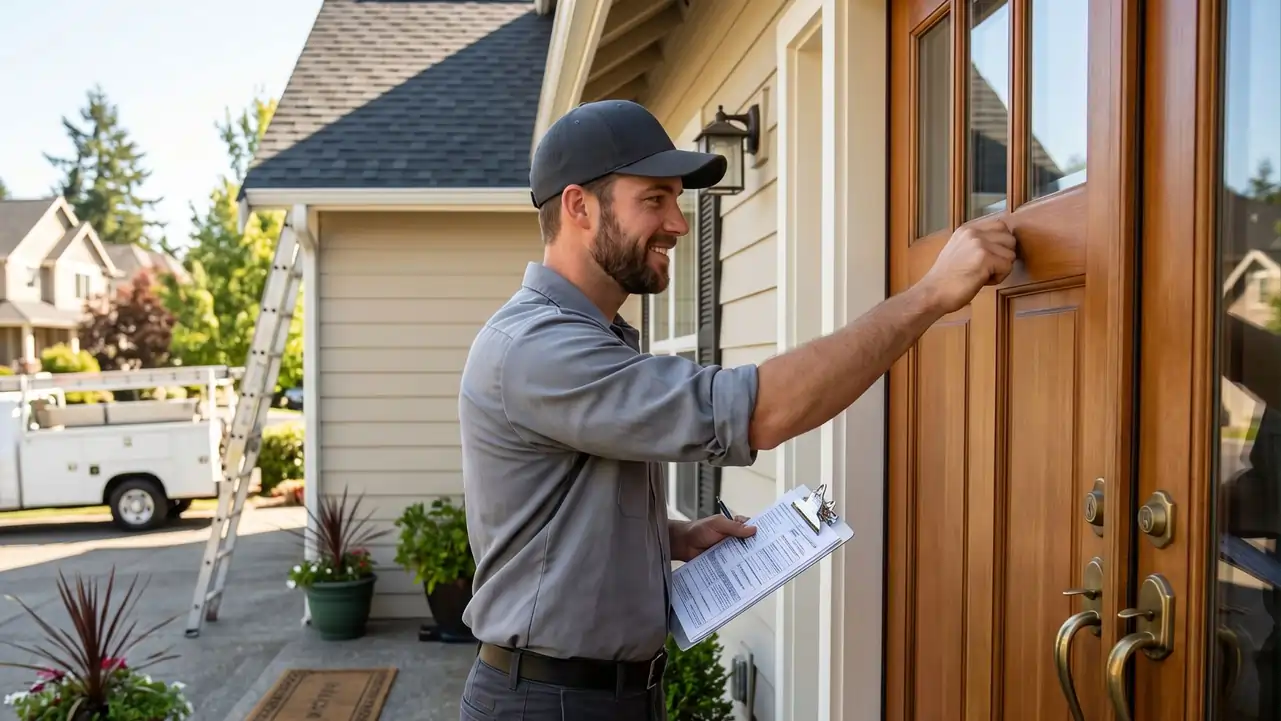
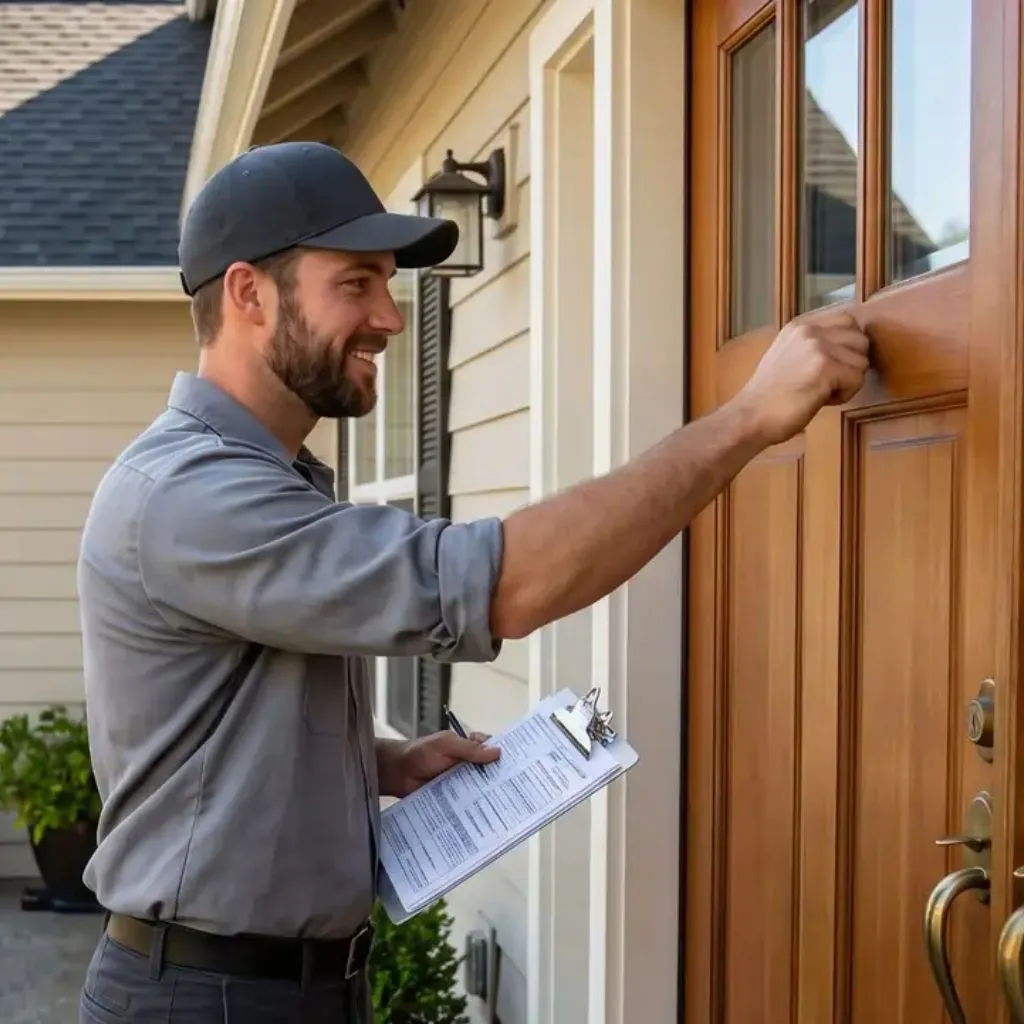
Roofing is one of the few industries where door knocking is still a viable source of leads. Despite this, a majority of new roofers avoid or ignore door-to-door sales. The few that try it don't know the tactics and end up with subpar results.
We're here to help you get the best value out of your door to door campaigns. We'll go through a 7 step process that will help you understand and succeed at your door knocking campaign. Here's the quick version:
Door-knocking is one of the most affordable and successful customer-facing lead generation tactics for roofing businesses. A well executed door-knocking campaign has an average cost of $5 per knock with a success rate of 2 to 5%.
You spend around $500 for 100 knocks and get 2 to 5 residential roofing jobs. An average residential roofing job costs $4500 in the US, with 20% to 40% net roofing profit margins. Simply put, you make at least $9000 to $22500 by spending $500.
Estimates only. Actual results vary by market, crew, and close rate.
The silver lining is that you get better at it the longer you do it. Plus, door knocking is a compounding source of leads. You get valuable customer info, establish first contact, and leave your mark on the neighborhood.
Door knocking sounds simple and it is WHEN you have an actual plan. We've written down the complete plan from step 1 to 7 to help you succeed in your door knocking campaign.
The first obvious step is getting your Illinois roofing license. Selling, promoting, or soliciting any roofing service without a license is a major breach of law in Illinois. You could be fined up to $5000 per violation for unlicensed roofing, so please get your license.
Door knocking and canvassing is primarily for residential roofing jobs. This means you can start knocking on any residential property as long as you have a:
Getting a license is one of the hardest parts because the Illinois roofing exam is hard. Fortunately, we can help you with that through our tailored roofing classes.
We'll help you prepare for the exam and the career.
A strong sales pitch wins the first 10 seconds at the door. Prospeo's 2026 sales research shows 73% of customers say product knowledge is what they need most from a sales rep. So make your pitch from an authoritative perspective.
As a roofing contractor, your pitch should answer three questions in under 30 seconds:
Do not use unnecessary jargon and be as eloquent as possible. The are 5 necessary parts of a winning door to door roofing sales pitch:
Practice the pitch until it sounds like a conversation. Your pitch should sound something like this:
Hello, how are you doing? ... I came here to introduce myself, I am Aragorn from Middle Earth Roofing. [context reason: yesterdays storm did a number on the folks here]. I was driving past the neighborhood and saw your roof, [reason: it looks like its missing some shingles]. Is it okay if I check your roof? I saw some missing shingles and that could turn into a leaking roof pretty soon. I can do a quick roof inspection to check the damage. It doesn't take long and its completely free.
Picking the right neighborhood matters as much as the pitch itself. A great pitch in the wrong zip code still ends in a slammed door. It's like selling engines to a baker.
Look for areas that have recently experienced storms or areas with extreme seasonal weather. NOAA Storm Prediction Center reports more than 5,000 hail events across the US in a typical year.
Roofers who arrive within 60 days of a storm see the strongest homeowner response. You can fine tune your search perimeters by:
Canvass each area three times to reach roughly 90% of homeowners. Use a CRM heat map to track which streets convert best for your sales team.
You have free will, so technically you can knock on every door across Illinois. Realistically, that's a waste of your time, fuel, and effort. Not every house on the street is a qualified lead and your goal is sifting out the qualified ones.
How do you do that? Use your skills and experiences to do a quick ground level visual scan. Look for the following visual signs:
Skip vacant houses, homes with brand new roofs, and properties with No Soliciting signs. The last one seems rough, but you MUST respect the sign every time. A respected sign builds reputation for the entire roofing industry.
The pitch starts the moment the door opens. A door knocker has roughly 10 seconds to make a first impression, so you better be smiling when you see the person on the other side of that door. Don't get nervous, just act like you're talking to an acquaintance.
Don't act like an average salesman storm chaser because that door is going to close quick. If a homeowner isn't warming up to the idea, ask for the reason. Learn to ask the right questions in different situations.
For example, if someone denies the free inspection, ask the following questions:
After the pitch, track your leads and leave a business card. This is crucial irrespective of whether the pitch was successful or failed monumentally. Track key points like:
Top door knockers hit 50 to 70 doors per day. Disciplined tracking turns those numbers into a measurable, repeatable sales process. You can use different roofing CRMs to expedite the process or do it all manually.
The best door knockers shift the pitch in real time based on what they see and hear at the door. If the homeowner brings up insurance, lead with the insurance claim angle. If they bring up cost, lead with the free inspection and the deductible math.
Listen to the homeowner and adapt your pitch. Improv is a door knockers best friend, so work on those skills. Here are some scenarios and their adaptations:
Practice with yourself, a friend, or a partner before knocking on doors. Go through the potential conversations, points, counter points, until you stop stammering.
Most roof replacements take more than one conversation to close. Persistence separates successful roofing pros from one and done knockers. Prospeo's 2026 data shows top performers canvas each area three times before reaching 90% of homeowners.
Follow up with everyone, because your next potential customer could already be in your lead list. Here's a reliable follow up system for you:
A lot of roofers fumble the pitch and end up losing clients the moment they start speaking. So work on your pitches and make them impactful. Here are three example pitches you can adapt to their own voice and market.
| Scenario | Example Pitch |
|---|---|
| Post storm hail neighborhood | Hi, I'm Jake with ABC Roofing, license #105.123456. I was inspecting roofs on this street after last week's hail. Some of the roofs around here took a beating. We just finished one two doors down. Mind if I do a quick roof check for you at no cost? |
| Older roof, no storm | Hi, I'm Mike with ABC Roofing. We've been replacing roofs in the neighborhood and I was driving by when I saw yours. It looks a bit rough and I just wanted to give you a heads up. If you want I can do a free 15 minute roof inspection today or this week? There's no cost and it might save you from mounting bills down the road. |
| Visible damage from ground | Hi, I'm Sara with ABC Roofing, license #105.123456. Hope you're having a great day. I was walking by and noticed missing shingles on the back slope from the street. I'd be glad to take a closer look at no cost. There's no cost or fine print. I'll just look at the roof and tell you if its serious. |
Notes on what makes these pitches work for door to door roofing sales:
Also give the homeowner an out if he isn't up for an inspection right away. For example, if the homeowner says something like "No, I'm busy right now," tell them "That's fine, we can schedule a roof inspection tomorrow if it works for you."
Yes, door knocking is legal for licensed roofing contractors in most US cities. Some HOA neighborhoods and municipalities require a solicitor's permit, so check local rules first. Always respect No Soliciting signs and carry proof of your state roofing license at every door.
The best window is between 4 PM and 7 PM on weekdays, when most homeowners are back from work. Saturdays from 10 AM to 2 PM also see strong contact rates. Avoid Sunday mornings and any time after sunset for safety and reputation reasons.
Top performers convert 2 to 5% of knocked doors into qualified roof inspections per Prospeo's 2026 sales data. Conversion improves with practice, neighborhood selection, and recent storm activity. A new door knocker should expect closer to 1% in the first 30 days.
Top door knockers hit 50 to 70 doors per day, based on Prospeo's 2026 D2D benchmarks. A new roofer should aim for 40 doors per day in the first month. Quality matters more than raw volume once a tracking system is in place.
Yes, plenty of roofing professionals knock year round in neighborhoods with aging roof systems. The pitch shifts from storm damage to roof age, energy efficiency, or a free preventive roof inspection. Conversion rates run lower, but the lead cost stays at $3 to $5 per knock.
Show a state roofing license, in state license plates, a local office address, and a branded uniform at every door. Never ask for full payment upfront, and cap deposits at 10 to 20%. A reputable roofing company always lets the homeowner verify credentials before signing a contract.
A written script helps new door knockers stay consistent in the first 90 days. Experienced reps adapt the script based on the homeowner's reactions and the property's visible condition. Track which openers convert best and refine the script every two weeks.
Mention insurance claims only after spotting visible storm damage. Lead with a free roof inspection and let the homeowner decide whether to file a claim. Never promise to "handle the claim" or guarantee an insurance payout, as that crosses into public adjuster territory in many states.
Door knocking for roofers still works in 2026 because conversion rates remain at 2 to 5% and lead costs stay under $5 per knock. Door knocking will always work for you as long as you follow the best practices.
Show your credibility, knock on the right doors, and handle each homeowner like a human. But before you can start knocking on doors, you'll need an Illinois roofing license.
Join our classes and we'll help you get one with tailored classes.



.jpg)