
How Much Do Roofers Charge Per Square? Labor Costs & More
Jul 27, 2025
Roofers charge $300 to $900 per square, based on materials, complexity, and availability of materials. In 2026, the national average roofing cost per square sits between $400 and $700, and our roofing industry report shows prices climbing 3% to 5% every year. As a roofer or contractor, it's important to understand these costs to avoid over- or undercharging clients.
Most roofers charge unreasonable amounts per square, which ruins customer relations or bankrupts the business. In this guide, we explore average material and labor costs, roofing prices per square by roof size, and Illinois-specific numbers so you can make an informed decision before signing any contract.
Average Roofing Cost per Square Overview
On average, replacing a roof can cost from $300 to $900 per square (100 square feet). This cost includes tearing off old shingles, buying new materials, and installing them. These figures are mercurial and often region-specific.
Here's an overview of typical roofing prices per square to put things into perspective:
- National Average: $400 to $700 per square.
- Budget Roof (Asphalt Shingles): $350 to $550 per square.
- High-End Roof (Metal or Tile): $800 to $1,500+ per square.
In Illinois, the average roof replacement cost per square runs from $413 to $604 statewide, and $547 to $811 per square in the Chicago metro. You have to understand these costs and the factors that influence them to give clients the right estimates.
Factors that Influence Roof Cost Per Square
The average cost to replace a roof completely depends on material, labor, roof size, and various other factors. However, here's a rough estimate of regional pricing ranges for a roof installation per square:
This figure can change because of factors like:
- Roof Pitch: Steeper roofs require more effort and time, adding 20% to 40% to the price
- Home Story: Roofs of multi-story homes are harder to work on and riskier
- Type of Roof: Certain roofs are harder to work on because of the structure
- Roof Layers: Roofs with multiple layers require tear-offs and cost more
- Job Goals: Roof repairs require fewer materials compared to replacement
Furthermore, commercial and residential roofing work have different costs per square. For example, a commercial roofing job will pay more compared to residential jobs. This happens because commercial roofing jobs have stricter regulations, extensive paperwork, and skill requirements.
Roofing Material Costs per Square
The type of roofing material you choose significantly impacts the roof replacement cost. On average, roofing materials might cost between $100 and $450 per square, and suppliers have raised prices 3% to 5% each year since 2024. However, there are tens of different types of roofing materials for contractors to work with.
Here's a brief comparison list that may help you understand how much roofing material per square costs by type.
|
Material Type |
Average Cost per Square |
Cost Factor |
|
Asphalt Shingles |
$150 - $250 |
These are common, easy to handle, and install. |
|
Architectural Shingles |
$200 - $350 |
These are thicker, more durable, but harder to install. |
|
Metal Roofing |
$350 - $650 |
Great material, but complex and time-consuming to install. |
|
Clay or Concrete Tile |
$450 - $900 |
Very heavy and brittle, making them hard to manage and install. |
|
Wood Shakes/Shingles |
$300 - $450 |
Easy to acquire and install, but requires precision and ingenuity. |
Generally, tile roofs have the highest cost per square, because they require superior skill, more labor, and time. Asphalt shingle roofs are much easier to install and carry, which brings down their cost per linear foot.
Roof Types and Per Square Cost
The type of roof (structure) can significantly affect the cost per square. For example, flat roofs are safer and easier to work with, bringing down labor and installation costs. A mansard roof is much harder to work with because of its structure, which increases its cost.
Here's an overview of different roof types and their average cost per square:
| Roof Type | Average Cost per Square | Reasons for Cost |
|---|---|---|
| Gable Roof | $300 – $600 | Simple design, easy installation, low material waste, and widely available materials. |
| Hip Roof | $400 – $700 | More complex framing, more materials than gable, requires skilled labor. |
| Mansard Roof | $600 – $1,200 | Complex structure, high labor costs, multiple slopes, and often needs custom materials. |
| Flat Roof | $350 – $800 | Requires special waterproofing, drainage systems, and labor-intensive sealing processes. |
| Shed Roof | $250 – $500 | Single slope, easy to build, minimal framing, but limited to smaller buildings. |
| Gambrel Roof | $500 – $800 | Similar to barn roofs, complex shapes, high material use, and more difficult to install. |
| Butterfly Roof | $600 – $1,000 | Modern aesthetic requires advanced waterproofing and drainage, complex framing. |
| Clerestory Roof | $700 – $1,100 | Includes vertical windows, needs structural reinforcements, difficult installation. |
| Combination Roof | $750 – $1,300 | Combines two or more types, increases labor time and complexity, and custom design costs. |

You can think about this in terms of roof pitch (elevation angle or slope). The cost and difficulty of a roof installation are directly correlated to the pitch. The steeper a roof is, the more a roofer will charge for work.
Roofing Job Types and Cost Per Square
The cost of a new roof is higher than the cost of repairs and minor replacements. This happens because installing a new roof requires the removal of the previous roof. The time and effort it takes to install a new roof leads to higher labor costs.
| Roofing Job | Average Cost per Square | Reasons for Cost |
|---|---|---|
| Roof Replacement | $400 – $1,000 | Includes removal, disposal, new materials, labor; varies by roof type and material used. |
| Roof Repair | $150 – $600 | Depends on the extent of damage, the location of repair, materials needed, and urgency. |
| Roof Removal (Tear-Off) | $100 – $300 | Labor-intensive, involves disposal fees, old roofing condition affects pricing. |
| Roof Overlay (Re-Roofing) | $250 – $600 | Skips removal, uses fewer materials, but may shorten lifespan of new layer. |
| Flashing Replacement | $300 – $500 | Requires precision, works around chimneys, skylights; uses metal and sealants. |
| Gutter Installation | $150 – $400 (per square) | Includes downspouts and hangers; varies with gutter type (aluminum, copper, etc.). |
| Skylight Installation | $500 – $1,200 (per unit) | Involves cutting the roof, flashing, and sealing; prone to leaks if not installed properly. |
| Roof Inspection | $100 – $300 (flat rate) | Includes manual check, drone inspection, or infrared scanning; may be waived with repairs. |
Common roofing procedures are often less labor-intensive, which decreases labor costs. You must understand the types of roofing jobs and their impacts on labor costs. Doing this will help you make more accurate judgements about estimates.
Note: Emergency roof repairs or work have higher costs because you are abandoning other work to invest in that specific project.
Roofing Cost by Roof Size (10 to 40 Squares)
Clients rarely ask about the price of one square. They ask what their whole roof will cost. Most residential roofs in the US fall between 15 and 30 squares (1,500 to 3,000 square feet of roof surface).
Here's what different roof sizes cost with standard asphalt shingles versus premium materials like metal or tile:
| Roof Size | Square Feet | Asphalt Shingles | Metal or Tile |
|---|---|---|---|
| 10 Squares | 1,000 sq. ft. | $3,500 – $5,500 | $7,000 – $12,000 |
| 15 Squares | 1,500 sq. ft. | $5,500 – $9,000 | $11,000 – $18,000 |
| 20 Squares | 2,000 sq. ft. | $8,000 – $14,000 | $16,000 – $24,000 |
| 25 Squares | 2,500 sq. ft. | $9,500 – $15,000 | $20,000 – $30,000 |
| 30 Squares | 3,000 sq. ft. | $10,500 – $16,500 | $24,000 – $36,000 |
| 40 Squares | 4,000 sq. ft. | $16,000 – $28,000 | $32,000 – $48,000 |
Remember that a roof's surface is usually 20% to 30% larger than the home's footprint. Pitch, overhangs, and dormers all add square footage. A 2,000 sq. ft. home often carries a 2,400 to 2,600 sq. ft. roof, which means you'd quote 24 to 26 squares, not 20.
Roofing Cost Per Square Calculator
Use this interactive roofing cost per square calculator to generate a quick ballpark for any job. Pick the material, set the roof size in squares, and choose the pitch. The tool applies current 2026 per-square rates and shows the labor and material split.
Roofing Labor Cost per Square Foot
A roofing project isn't just about nails, hammers, and materials. You have to charge for the effort it takes to use those materials and the time you invest. On average, roofing labor costs range from $1.50 to $4.50 per square foot in 2026.
Moreover, project complexity and your location can increase labor costs. Meaning, you charge almost $150 to $450 per square for the labor. In Illinois, roofing labor typically falls in the $200 to $300 per square range, with Chicago crews at the top of that band. For clarity, you are charging this amount for:
- Removing the old roofing materials, such as shingles, nails, etc.
- Applying a moisture barrier or a felt layer on the roof.
- Sealing around chimneys, vents, and edges during the roofing job.
- Removing debris, sweeping for nails, and hauling waste from the new roof.
- Carrying materials, managing their integrity, and your skill.
Two situations change the math. Metal roofing labor cost per square runs 30% to 50% higher than shingles because panels need precise cutting, seaming, and fastening, which is why becoming a metal roofing contractor pays so well. Roofing labor cost per square for new construction runs 10% to 20% lower because there's no tear-off, the deck is clean, and the site has open access.
Charge the client for your skill, experience, effort, and time. While you're doing this, remember that it's not about charging someone more. Be honest, truthful, and realistic when you're generating estimates.
How Much Do Roofers Charge Per Hour or Per Day?
Some clients ask for hourly numbers instead of per-square pricing, especially on repairs. Most roofers charge $40 to $80 per hour per worker in 2026. Highly skilled installers working slate, copper, or standing seam metal can command $100+ per hour.
Day rates work differently. A full crew of 4 to 6 roofers typically bills $1,500 to $3,000 per day, depending on region and experience. Here's why per-square pricing still beats hourly for most jobs:
- Per-square quotes give the client one fixed, predictable number.
- Hourly billing punishes fast, experienced crews and rewards slow ones.
- An experienced crew installs 20 to 40 squares of asphalt shingles in a single day on a walkable roof. Our roofing project timeline guide breaks down the pacing.
- Hourly rates make sense only for small repairs, diagnostics, and change orders.
Roofing Labor Cost vs. Material Cost for Roofers
Every roofing estimate is a combination of the material and labor costs. You must understand different roofing needs and charge the right amount for labor costs. On average, the cost per square of a roof is divided into:
- 40% to 60% Labor Costs
- 40% to 60% Material Costs
The ratio depends on the roof's needs, its size, and regional labor costs. Here's an overview of the ratios between labor and material for different roof types:
|
Project Type |
Labor |
Material |
Reason |
|
Asphalt Shingles |
~40% |
~60% |
Easier installation and lower labor time. |
|
Metal Roof |
~50% |
~50% |
More complex to install, which increases the labor hours. |
|
Steep or multi-level roof |
~60% |
~40% |
Requires more crew and safety equipment. |
|
Flat roof |
~40% |
~60% |
Easier to install, but membrane materials can add to the cost. |
For example, if you've a 2,000 sq. ft. shingle roof and your roofer or a roofing contractor is charging $600 per square total for a roof replacement. Here's a breakdown of the cost:
Total Cost: 20 squares x $600 = $12000
- Materials (60%): 20 x $360 = $7200
- Labor (40%): 20 x $240 = $4800
The labor cost minus the overhead cost is your take-home income. That is the amount that defines how much roofers make across the US, and eventually how much roofing company owners make once they scale.
Roof Replacement Cost in Illinois (2026)
Illinois deserves its own numbers because our weather punishes roofs harder than most states. Freeze-thaw cycles, hail, 60 mph Chicago wind gusts, and the occasional derecho keep replacement demand high. That demand shapes what Illinois roofers can charge per square.
Here's what the 2026 Illinois market looks like:
- Statewide average: $413 to $604 per square for asphalt shingle replacement.
- Chicago metro: $547 to $811 per square, with an average around $647.
- Typical full project: $8,000 to $20,000 for an average Illinois home.
- Illinois labor: $200 to $300 per square, roughly 10% to 25% above neighboring Indiana, Iowa, and Missouri.
Union labor premiums, stricter Cook County building codes, and higher permit fees explain the Chicago markup. Nearly every Illinois municipality requires a roofing permit for full replacement, and permits run $100 to $500 in most towns. Learn the different types of Illinois roofing permits and build both into every quote you write.
Commercial Roofing Cost Per Square Foot
Commercial roofing costs per square foot run $4 to $12 for flat and low-slope systems like TPO, EPDM, and modified bitumen. Commercial work is usually quoted per square foot rather than per square because the projects are large and the systems are membrane-based.
Commercial jobs carry costs that residential work doesn't:
- Stricter safety planning, insurance requirements, and OSHA compliance.
- Engineered drainage, insulation boards, and code-mandated wind uplift ratings.
- Longer paperwork cycles, bonding, and multi-phase scheduling.
Those extras are exactly why commercial roofing pays more per crew hour. Compare the two sides of the trade in our residential vs commercial roofing guide, and see how the margins stack up in our breakdown of roofing net profit.
How Can Roofers Estimate Roof Costs
Now, we're at the chunk where you will learn how to generate a roofing estimate. Here's a breakdown of the overall process every reputable roofing contractor should take:
- Inspect the existing roof slope, wear, damage, and underlying issues.
- Think about the materials you'll need for the repair or replacement.
- Measure the size of the roof and calculate the pitch and slope for labor costs.
- Take satellite images or use drones to save time and improve accuracy.
Roofing companies and individuals can use roofing CRM software to estimate the size, materials, and costs. If you're doing it the old-fashioned way, here's how you make an estimate:
- Labor Costs (per one roofing square for labor or per hour)
- Material Costs
- Cost to Tear and Dispose (if required)
- Overhead (fuel, roofing permit, and equipment)
- Profit Margin
Here's a simple formula to help you make the estimates:
Total Roofing Estimate = Material Cost (Total Squares) + Labor Cost (Estimated Hourly Wage Per Job * Crew) + Overhead Costs (Fuel + Permit + Equipment)
The roofing estimate should have the same 40 to 60 ratio. Based on the roof type, you can charge 40% to 60% for the labor costs. Add a 15% to 25% profit margin on top so the business grows instead of just surviving.
What Does “Per Square” Mean in Roofing?
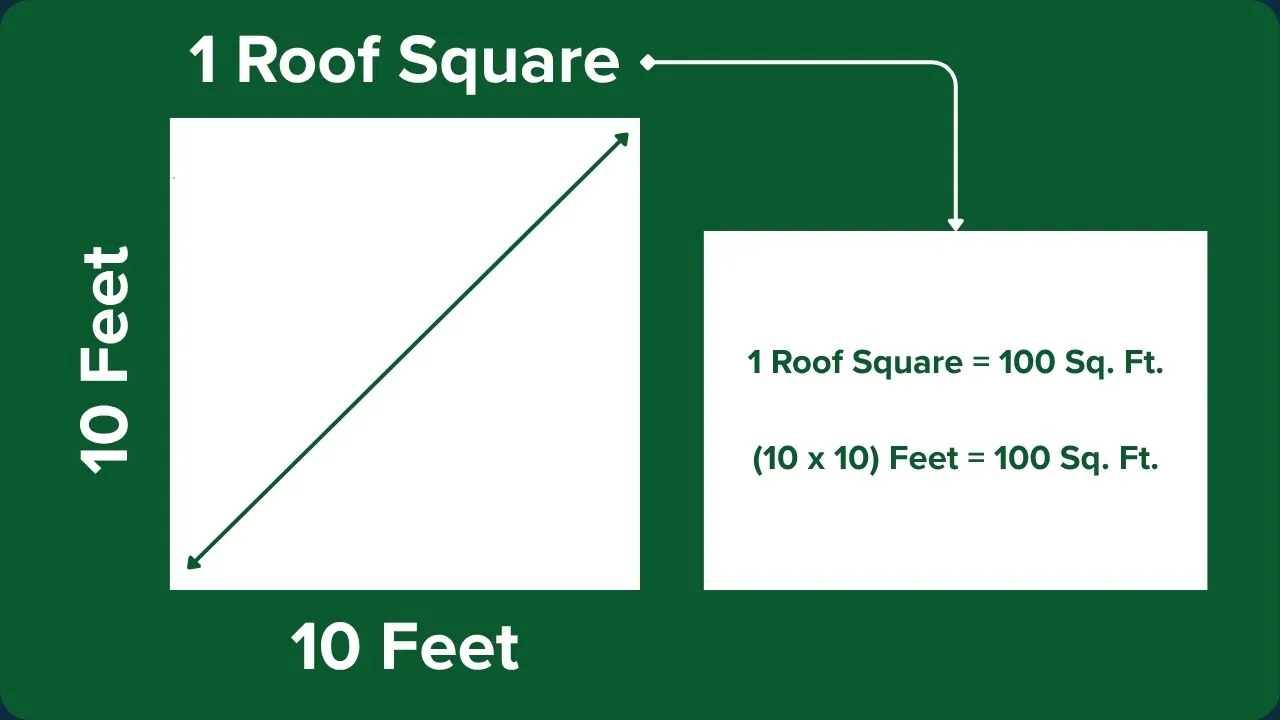
In roofing, "per square" refers to the cost for every 100 square feet of roof area. When a roofer says a roofing project will cost $450 per square, they mean $450 for every 100 square feet, and not a square foot. It's one of the first roofing terminologies every contractor should master.
Roof Square vs Square Foot
Here's a brief explanation of the differences between a roofing square vs a square foot:
- 1 roofing square equals 100 square feet
- 100 Square Feet is 10 feet in Length x 10 feet in Width
- If your roof is 2,000 square feet, it equals 20 squares
Why Do Roofers Use This Unit?
This unit helps roofers simplify estimates and standardize pricing across projects of different sizes. Other reasons why roofers use this unit are:
- Roofing materials are manufactured and bundled to cover one square.
- Labor charges are estimated by how many squares can be installed per day.
- Price per square makes estimation, ordering, and quoting more consistent.
We recommend generating estimates based on this unit. It makes approximations for roofing net profit much easier, which also translates to clearer and transparent quotes.
FAQs on Roofing Charges for Roofers
What do most roofers charge per square?
Most roofers charge between $350 and $550 per square (100 square feet) for shingle roof replacement, depending on materials, roof complexity, and location. Premium materials like metal or tile can cost $700 to $1,200+ per square in 2026.
How much is 10 squares of roofing?
The cost of 10 squares of roofing typically ranges from $3500 to $5500 for asphalt shingles, including labor and materials. For premium materials like metal or tile, the price can exceed $7000 to $10000, depending on complexity, location, and roof pitch.
How much is a 20 square roof?
A 20 square roof (2,000 square feet) costs $8,000 to $14,000 for an asphalt shingle replacement in 2026, including tear-off, materials, and labor. Metal or tile on the same roof can run $16,000 to $24,000 or more.
How much is 30 squares on a roof?
The cost of 30 squares on a roof ranges from $10500 to $16500 for asphalt shingles, including labor and materials. The cost changes significantly based on the materials you're using, roof type, and labor.
How much do roofers charge per hour?
Roofers charge $40 to $80 per hour per worker on average in 2026. Specialty installers working slate, copper, or standing seam metal can command $100+ per hour, and a full crew day rate runs $1,500 to $3,000.
Why do roofers charge so much?
Roofers charge what they do because every estimate covers skilled labor, insurance, safety gear, permits, disposal fees, fuel, and business overhead, not just shingles. Running a roofing operation carries real startup and overhead costs, roofing is one of the most dangerous trades in the US, and material prices have climbed 3% to 5% every year.
Do roofers charge for estimates?
Most residential roofers offer free estimates and treat them as a sales opportunity. Detailed inspections that use drone imaging or infrared scanning may cost $100 to $300, and many contractors credit that fee toward the project if they win the job.
How many squares can a roofer install in a day?
An experienced crew installs 20 to 40 squares of asphalt shingles per day on a simple, walkable roof. Steep pitches, multiple stories, and cut-up rooflines can cut that pace in half, which is exactly why those roofs cost more per square.
Bottom Line on Roofing Cost Per Square
The average cost per square of a roof ranges between $300 and $900, with the 2026 national average sitting at $400 to $700. On average, roughly 40% of a roofing project is the labor costs, while the other 60% accounts for material costs. These percentages change depending on the roofing material and the scope of work.
If you're a new roofer and having a hard time working out these estimates, we'll help you. We teach you everything about roofing in our Illinois roofing classes. We help you get the license, understand permit needs, and generate estimates and invoices. Join our classes today and become the best in your trade.
Prepare for your career!
We help you with the license and post-license complications.